

How the Kremlin clamps down on the Communist Party
"We’ll fight for Oleg together!"
The Russian Communist Party supports the war and domestic repressive legislation, yet its own supporters, including senior party figures, are also facing political persecution. The Barents Observer examines how the party manoeuvres between servility and opposition — and who ultimately pays the price.
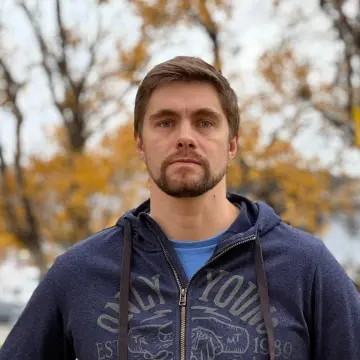
Party members are being designated ‘foreign agents’, barred from standing in elections and even sent to prison, as happened to Oleg Mikhailov, a former MP from the Komi Republic.
On 23 October, a young man appeared in the central square of Syktyvkar holding a small placard. Against a red background, white lettering read: ‘When they came for the communists, I did not remain silent!’ The slogan alludes to a famous quotation by pastor Martin Niemöller, who in Nazi-Germany in the late 1930s explained what happens when people fail to resist repression. The one-man picket in the capital of the Komi Republic was intended to show support for Oleg Mikhailov, a former Member of Parliament (MP) - the State Duma - who was arrested under one of the Russian Criminal Code’s most frequently used political charges: justifying terrorism.

Mikhailov is more than just a well-known regional politician. He is a member of the party's Central Committee, and his profile remains on the party’s official website — albeit with a note stating that he has been added to Russia’s list of ‘extremists and terrorists’.
A local politician who knew Mikhailov well and agreed to speak to the Barents Observer anonymously says his former colleague has become a victim of the ‘rules of the game’.
"The Communist Party understands that there are certain red lines, but it also understands that it cannot achieve electoral results without crossing them. Despite electoral fraud, how people vote still matters to some extent. And to achieve that, you need a certain level of popularity. But those who cross these red lines can be sacrificed."
A crackdown
Telegram channels associated with the Communist Party in Komi say the criminal case against Mikhailov is based on a post supporting sociologist Boris Kagarlitsky and left-wing activist Sergei Udaltsov. Both have also faced prosecution under the law against justifying terrorism and are now in prison.
Mikhailov’s fellow party members have come to his defence — including on the Communist Party’s official website. Prominent communist MP Yuri Sinelshchikov, for example, accompanied his statement of support with the word ‘reprisal’. The former prosecutor lamented that people were ‘somehow ending up in criminal proceedings for reasons that are not at all clear’.
MP Nina Ostanina has also spoken out in Mikhailov’s defence, describing her fellow party member as an ‘outspoken oppositionist’ and an ‘inconvenient politician’. Ostanina is one of the Communist Party’s most prominent figures and has sat in the State Duma since 1995.
Like the overwhelming majority of her fellow party members, Ostanina supported the invasion of Ukraine and the repressive laws introduced in recent years, including the legislation imposing wartime censorship in Russia. She also played a part in introducing the Criminal Code provision on justifying terrorism, the charge now being brought against Mikhailov.

Nevertheless, in an interview with the Barents Observer, Ostanina describes the case against Mikhailov as political. In her view, it is an act of revenge by the regional authorities, whom the former MP had repeatedly criticised.
Asked what she thinks of the criminal cases against Yevgenia Berkovich and Svetlana Petriychuk, who are also in prison on charges of ‘justifying terrorism’, Ostanina does not answer. Instead, she turns the conversation to the arrests of her own allies in Moscow.
On 4 October, 55 activists — young communists and students — were arrested and taken away in police vans at a perfectly legal rally organised by the Communist Party of the Russian Federation. We hold it every year to commemorate the victims of the shooting of the Supreme Soviet deputies. This was a rally that had been approved by the mayor’s office. So how can that not be political persecution?" Ostanina asks indignantly. "We’ll fight for Oleg together!"
A sacred victim
Nina Ostanina is right that Communist Party members and supporters are facing repression.
In the autumn, Nurlan Munzhasarov, a member of the regional legislature in Orenburg and an aide to Ostanina, was disqualified from standing in elections. Investigators found an old post of his featuring the logo of Alexei Navalny’s ‘Smart Voting’ initiative — content they classified as extremist.
Popular communist Nikolai Bondarenko from Saratov Region was barred from standing in elections for a similar reason. He had made a name for himself by attempting to live on 3,500 roubles a month, the amount then used to calculate the standard consumer basket.
Bondarenko campaigned against pension reform, supported Navalny when he returned to Russia and accused the Central Election Commission of electoral manipulation. In 2026, he stood for the State Duma, but a month before the election, a photograph of Navalny was conveniently ‘discovered’ on his Telegram channel.
The security services used the same tactics against Yabloko, eliminating the most prominent representatives of Russia’s only anti-war party from the election race as early as the spring.
According to Yevgeny Stupin, a former MP who has been designated a ‘foreign agent’, the persecution of communists serves the interests of the party itself, which supports the Kremlin’s key policy priorities.
"The leadership, which has nothing to risk for the time being, votes for the very laws used to repress party members. It even benefits them: those who are persecuted are presented as sacred victims, and the party uses that to boost its ratings and get into the Duma. Everything works perfectly. There is no contradiction at all," says the former MP.
Stupin is originally from Severodvinsk but built his political career in the capital. He was a member of the Communist Party faction in the Moscow City Duma, but was expelled from the party in 2023 for signing an anti-war appeal. Shortly afterwards, the Ministry of Justice designated him a foreign agent.
Stupin is not the only person associated with the Communist Party to have received that designation. In 2024, municipal deputy Pavel Ivanov was given the same status. His fellow party members came to his defence, accusing the authorities of persecuting people for their views.
The first MP in Russia to be designated a ‘foreign agent’ was Viktor Vorobyov from Komi. Although he was not a CPRF member, he led the party’s faction in the regional parliament — a position he had inherited from Oleg Mikhailov when Mikhailov moved to the State Duma.

"Slipping between the raindrops"
After Russia launched its full-scale invasion of Ukraine, Mikhailov did not make anti-war statements, but neither did he publicly support the war. His opponents repeatedly used that ambiguity against him.
In 2023, for example, provocateurs wearing military uniforms and concealing their faces turned up at a meeting between Mikhailov and his constituents. They demanded that the MP state clearly whether he supported the invasion of Ukraine. Mikhailov evaded the question.
Like other MPs in the eighth State Duma, Oleg Mikhailov is subject to numerous sanctions for supporting the war in Ukraine. At the same time, he did not vote to ratify the friendship and cooperation treaties with the self-proclaimed Donetsk and Luhansk People’s Republics — although around 50 other MPs from various factions also abstained — or for the wartime censorship law, despite being sanctioned over that legislation as well.
"Mikhailov is certainly anti-war," says one of his former allies.
"Yes, he was slipping between the raindrops, but he did not vote for the most outrageous bills. That was precisely why he was hauled in to see the higher-ups and made to explain himself."
Which initiatives did Oleg Mikhailov support — and which did he oppose?
In 2021, Mikhailov joined other communists and MPs from the party A Just Russia in voting for a proposal to launch a parliamentary investigation into the torture of prisoners. United Russia blocked the proposal.
Mikhailov did not vote for the law allowing Russia to disregard European Court of Human Rights rulings, the introduction of the terms ‘mobilisation’ and ‘wartime’ into the Criminal Code, or the incorporation of occupied Ukrainian regions into the Russian Federation.
Along with five other MPs, Mikhailov voted against a law establishing controls over people deemed to be under foreign influence.
Mikhailov did not vote for the law banning ‘gender reassignment’. However, according to Meduza, he supported the ban on ‘LGBT propaganda’, the prohibition on adopting children to countries where gender reassignment is permitted, and the law establishing pre-trial detention centres for the Federal Security Service (FSB).
In 2025, Mikhailov proposed a bill to increase payments to veterans of combat operations. A source close to the former MP told the Barents Observer that the proposal was intended as "political trolling".
"The idea was this: United Russia would vote against guarantees for veterans, and we would be able to say, “Just look at how United Russia really treats you.” In the end, they would not even let him present the bill."

Mikhailov stood in the September elections under the slogan ‘Peace, not wars; taxes to the Republic, power to the people!’ In a post about the vote, he said he had voted ‘for peace, freedom, equality and justice’.
He lost the election to Stanislav Kochev, a participant in what the Russian authorities call the ‘special military operation’ (the war in Ukraine), who was nominated by the ruling party.
Mikhailov’s Telegram channel, Voice of the Republic, was the only source of information about the numerous irregularities during the vote in Komi. It was there that a video went viral showing an election observer from the Communist Party counting ballot papers already marked for United Russia and apparently prepared for stuffing into ballot boxes.
Communists in Komi also organised Russia’s first rally against fraud in the September elections. The young Communist Party member who organised it was later penalised for allegedly exceeding the permitted number of participants.
Just one month separated Mikhailov’s loss of his parliamentary seat from his becoming a political prisoner. He knew that the authorities might come for him. In mid-September, he released a video in which he described how Komi head Rostislav Goldstein had spoken behind closed doors about the criminal case against him. Mikhailov called it a provocation.
Living people versus political deadwood
The standard agenda of any opposition politician includes low wages, the ‘streamlining’ of education and healthcare services, and a crumbling housing and utilities system. But Mikhailov also tackled more ‘specific’ issues.
Local communists, for example, supported activists campaigning to preserve the Komi language, which is the republic’s second official language. In 2023, a scandal erupted in the Komi State Council when Communist Party deputy Yekaterina Dyachkova was prevented from asking a question in her native Komi during a session.
"There are a lot of Komi people in our region, and many of them are members of the CPRF. During the protests in Shies, some of the speeches were delivered in Komi as well, so this issue mattered," explains Lana Pylyaeva, a journalist with the independent outlet Komi Daily who now live in exile.
According to Pylyaeva, local communists often worked alongside national activists. Mikhailov used anti-colonial rhetoric and periodically appeared in public carrying an alternative Komi flag, which had become one of the symbols of resistance. Before long, people began being fined for displaying the flag on the grounds that it was extremist symbolism, Pylyaeva says.
"If you want to pursue effective politics, you have to bring together all the different interest groups around you," says an ally of the former MP. "There are such groups in Komi, and you need to work with them. But Mikhailov genuinely cared about these issues; it would be wrong to say he was insincere."
Another strand of his activism involved resisting everything imposed from above, from QR codes during the pandemic to the surveillance-oriented messaging app MAX.

In March, Mikhailov complained to the Prosecutor General’s Office that students at Syktyvkar University were being forced to download the app. A student had recorded a conversation with lecturers who were urging students to install MAX under threat of expulsion.
"A voice recorder is the weapon of the proletariat!" the MP declared at the time.
In her conversation with the Barents Observer, Nina Ostanina described the Communist Party as Russia’s only genuinely opposition-minded party. However, the publication’s other interviewees believe that whatever opposition activity the party engages in is due almost entirely to people on the ground who are genuinely committed to the struggle for social justice.
It is a large party, and an ideological one. What binds its members together is not some supposed set of traditional values of the kind Putin talks about, but a dream of social justice," says Yevgeny Stupin, a communist designated a ‘foreign agent’.
"Yes, the Communist Party leadership is a group of people entirely dependent on the Kremlin. Yes, everyone finds [Communist Party leader Gennady] Zyuganov repellent — I have yet to meet anyone in the party who respects him. But people also understand that there are no other options at present. And many people join the Communist Party because they genuinely believe in its ideals and are critical of the current authorities."
According to Stupin, after the full-scale war began, some Communist Party members were expelled while others left of their own accord because of the party’s ‘unbridled support for the war’. However, some genuinely opposition-minded politicians remained — and, like Mikhailov, risk facing repression.
A politician who agreed to speak to the Barents Observer anonymously believes that in regions with a different political tradition, active people with opposition views might join A Just Russia or Yabloko instead.
Mikhailov, for instance, became widely known through the protests against a waste landfill at Shies. In Arkhangelsk Region, however, activists involved in similar causes entered politics under the banner of the Yabloko party.
"Party politics and party-building in Russia are dead. A political party is a simulacrum — just a stack of papers that allows you to take part in elections," the source told the Barents Observer.
"Ultimately, it all comes down to which regional branches of officially permitted parties have managed to attract living people, and which are nothing but political deadwood."


