
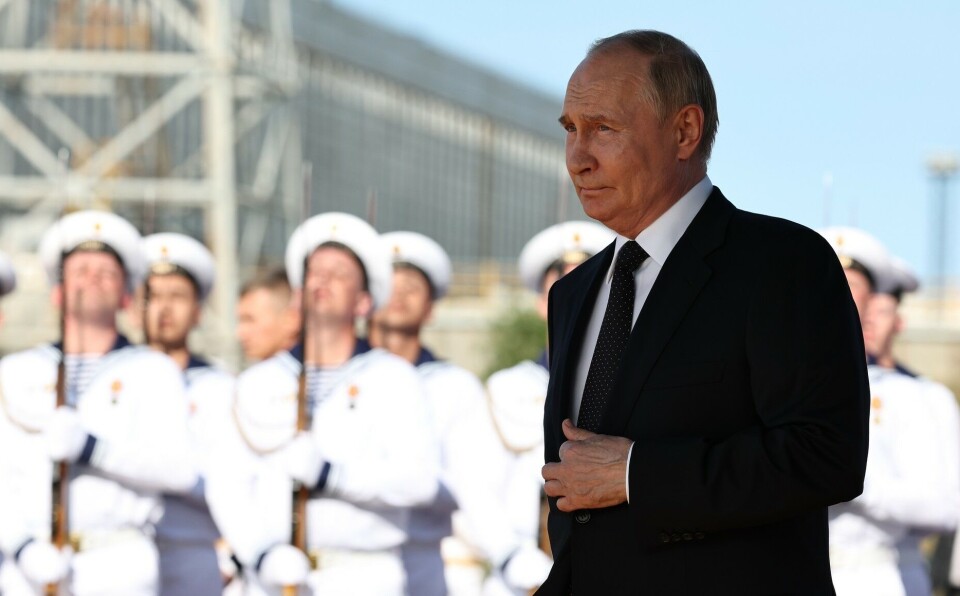
Putin’s popularity declines as war drags on
Russian dictator Vladimir Putin’s approval ratings continue to edge downwards amid successful Ukrainian drone strikes on Russian oil refineries and the resulting fuel shortages affecting almost every region of the country. Nevertheless, Putin appears unwilling to alter his course.
According to the latest survey by Russia’s state-run polling agency VTsIOM, conducted between 29 June and 5 July, both public trust in Vladimir Putin and approval of his performance declined once again. His approval rating fell to 66.0%, down from 66.9% the previous week, marking the second consecutive weekly decline. Public trust also dropped, from 73.3% to 72.3%, having stood at 76.7% two weeks earlier.
Political analyst Boris Pastukhov argues that the decline should not be viewed with excessive optimism. In his view, the Kremlin-controlled polling agency "needs to produce figures that resemble reality while still pleasing the country's leadership."
"If we take these figures at face value, the real story is that despite the fuel crisis and strikes on Moscow, Putin's approval rating remains above 60%, and by some measures above 70%. Any leader in the world, apart from Kim Jong Un, would envy such numbers. VTsIOM is effectively saying: 'Look, your attacks have reduced Putin's rating by half a percentage point. So what? How many more strikes would it take to push it below 50%?'"

Over the past six months, Ukraine has reportedly carried out 142 attacks on Russian oil facilities—the same number recorded during the whole of 2025, according to the independent outlet Vot Tak. As a result, several refineries have either partially or completely suspended operations. The Moscow Oil Refinery, for example, is reportedly unlikely to resume fuel production before 2027. Attacks on oil export terminals have also increased sharply, with more than half taking place along the Gulf of Finland.
According to calculations by Novaya Gazeta Europa, by the morning of 9 July the fuel shortage had spread to at least 80 Russian regions, as well as occupied Crimea and Sevastopol. Authorities in 46 regions have officially introduced restrictions on petrol sales, either across entire regions or in selected cities and districts.
Four regions—Penza, Irkutsk, Novosibirsk and Zabaykalsky Krai—have declared heightened emergency readiness. Meanwhile, several regions, including Mordovia, Nizhny Novgorod, Pskov, Astrakhan, Oryol and Lipetsk, have introduced fuel rationing based on vehicle registration numbers, with cars ending in even numbers allowed to refuel on even-numbered days, and odd-numbered registrations on odd-numbered days.
On 9 July, the Telegram channel Mozhem Obyasnit ("We Can Explain") reported that six Russian regions no longer had a single filling station with petrol available to the general public. The report was based on a fuel availability map launched by T-Bank. According to the service, no operational petrol stations were found in Kabardino-Balkaria, Ingushetia, Chechnya, Dagestan, Magadan Oblast or Chukotka.
Kalmykia reportedly had only one functioning petrol station, located in Elista. Astrakhan Oblast had just two, while Kaliningrad Oblast and North Ossetia also showed only two operational stations each. In Tuva, three stations remained open, two of them in the regional capital, Kyzyl.
The shortages have led to queues stretching for hours or even days outside filling stations, with reports of arguments, fights and increasingly political exchanges among motorists. In one video from Novgorod Oblast, a driver suggested that "Vova should be put in his place," while another clip filmed in Moscow sarcastically thanked Putin for the "unbelievable excitement."

However, Pastukhov does not believe such public frustration is necessarily translating into a collapse in support for Putin.
"People's attitude towards a government that is supposed to protect them from major geopolitical problems is undoubtedly deteriorating. But I don't think those feelings automatically transfer to Putin personally. For every video criticising him, there is another in which people say Ukraine is carrying out terrible attacks and Russia must retaliate even more forcefully. I don't think people are changing their views so much as becoming more radical in the views they already hold."
On 10 July, Deputy Prime Minister Alexander Novak was forced to acknowledge the seriousness of the situation.
"There are problems, and there is a shortage, which is why we are seeing queues."
He explained that the shortage had arisen because Russian refineries had been partially knocked out by drone strikes and were undergoing repairs. Novak had previously described conditions on the fuel market as "difficult but under control." He said the government had banned diesel exports in order to stabilise domestic supplies and also announced that Russia would begin importing petroleum products from abroad later this month.

Despite the worsening situation, Reuters, citing three sources close to the Kremlin, reports that Putin has rejected proposals for peace negotiations with Ukraine. According to the agency, the intensified attacks on Russia's oil infrastructure have only strengthened his determination to continue the war. One source who reportedly meets Putin regularly said there was a "high probability" of further military escalation in the coming months, although he did not specify what form this would take.
Putin first addressed the fuel crisis publicly on 28 June during a meeting with government officials. He insisted that Russia's fuel reserves remained sufficient and even suggested there was a risk of oversupply. In a separate interview with Kremlin journalist Pavel Zarubin, he said the shortages would be resolved by expanding air defence production, importing petrol and accelerating repairs to damaged facilities.
At another government meeting on 8 July devoted to the fuel crisis, Putin claimed that "the resilience of Russia's energy system is extremely high—among the strongest in the world" and called for the expansion of small-scale oil refineries. He also accused Ukraine of trying to create "an atmosphere of anxiety in society" through its attacks and expressed confidence that it would fail.
Pastukhov believes there are two reasons why Putin refuses to fully acknowledge the crisis: ideological and practical.
From an ideological standpoint, he argues, Putin cannot admit the scale of the problem because doing so would inevitably raise uncomfortable questions about its causes.
"You could say Russia doesn't have enough air defence systems. But then you'd have to explain why they're lacking, where they've gone, and why they became necessary in the first place. That's a slippery slope nobody in the Kremlin wants to step onto."
From a practical perspective, Pastukhov argues that the fuel shortage has not yet reached a level that seriously threatens Russia's ability to function. In his assessment, the comfort and welfare of ordinary citizens are simply not priorities for Putin.
"The military still has fuel, and military experts point out that modern warfare consumes far less fuel than the Second World War because there is much less reliance on heavy equipment. Food continues to reach the front. As for motorists waiting in queues... Putin seems to believe there are already too many car owners compared with when he was an ordinary citizen himself, and he doesn't regard their inconvenience as a major issue."
Meanwhile, Ukrainian President Volodymyr Zelensky told the Financial Times that the outcome of the war will ultimately be decided "by the battle in the skies."
"Today, it matters much less whose territory is larger. The conflict has moved into the air, and in the air we are now competitive."
According to Zelensky, the psychological impact of increasingly large-scale drone attacks on Moscow and St Petersburg, combined with mounting economic difficulties, will eventually weaken Putin's resolve to continue the war.
"When it is no longer one hundred drones flying towards Moscow but one thousand, he will understand. When he begins to experience it personally, when he sees it with his own eyes... his advisers will urge him to relocate somewhere beyond the Urals. And the further Putin moves away from Moscow, the closer the end of the war will be."


