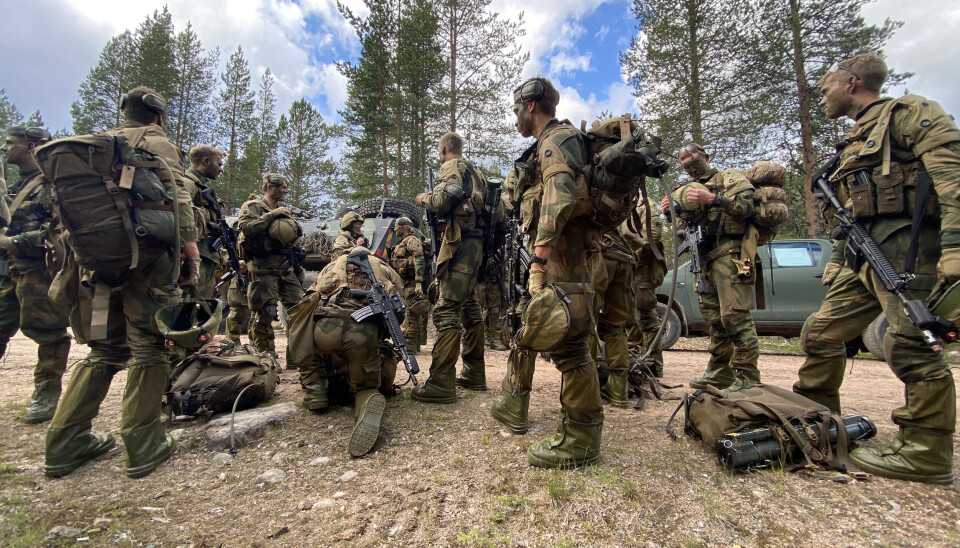
NATO activates forward land forces presence in Lapland
NATO’s Forward Land Forces Finland (FLF Finland) was officially launched on Saturday, 6 June, marking a significant step in strengthening Finland’s defence and reinforcing the Alliance’s northern flank.
Public support for NATO membership in Finland surged from 26 per cent to 60 per cent following Russia’s full-scale invasion of Ukraine in 2022. Four years later, a NATO battlegroup maintained at high readiness stands prepared for rapid deployment into the taiga forests north of the Arctic Circle to help defend Finland’s northern regions.
Sweden is leading the force with a battalion from the Norrbotten Regiment based in Boden, while operational command has been placed directly under NATO.
The ceremony on 6 June marked the first transfer of authority of Swedish troops to NATO command since Sweden joined the Alliance.
Sweden’s Minister for Defence, Pål Jonson, said his country takes the task of reinforcing NATO’s north-eastern flank seriously.
“Things have progressed quickly, and I welcome the positive and close cooperation with Finland, NATO and our Allies in this work,” Jonson said at the ceremony in Boden, which took place on Sweden’s National Day.
The United Kingdom, France, Italy, Denmark and Iceland have also announced their participation in the development of FLF Finland.

A multinational staff element will be based in Rovaniemi, while the Swedish-led battlegroup will remain stationed in Boden. The force is designed to operate across the North Calotte and, when required, rapidly reinforce NATO’s presence in northern Finland.
The Swedish battlegroup consists of around 600 personnel, with the capacity to expand to 1,200 troops if necessary.
To the north-east of Rovaniemi lies the Rovajärvi training area, Western Europe’s largest live-fire artillery and military training range.
“We will provide our Allies with an opportunity to exercise land warfare in Arctic conditions,” said Finland’s Minister of Defence, Antti Häkkänen, as the forward land forces began operations this weekend.
The expansion of military infrastructure in northern Finland and Sweden is a response to Russia's remilitarisation of its northern regions.
Moscow has announced plans to increase the size of its armed forces by 350,000 personnel. Up to 50,000 of these troops are expected to be assigned to the Leningrad Military District near the Finnish border, raising the number of soldiers in the district from approximately 30,000 today to around 80,000 over the coming years.
In Pechenga, a territory that belonged to Finland until 1944, the 200th Motorised Rifle Brigade has been reorganised and redesignated as the 71st Guards Motorised Rifle Division.
The transition from brigade to division suggests a substantial increase in personnel and equipment. However, there is little indication that the Pechenga base is currently undergoing a major modernisation programme. Russia's war against Ukraine has placed significant strain on military resources, limiting the capacity available for investments in Pechenga and other northern bases.
The reorganisation forms part of a broader restructuring of Russia's armed forces, including the re-establishment of the Soviet-era Moscow and Leningrad military districts and the dissolution of the Northern Fleet's status as a separate military district.
In addition to the division in Pechenga, Russia has established another division in Karelia. The 72nd Motorised Rifle Division was reportedly formed in 2024.