

Meet the Norwegian influencer that promotes Russia
A Norwegian man named Rudi Ripnes has been making laudatory videos about Russia for several years. He mocks the sanctions, admires the Russian Ministry of Defense’s cathedral, gives interviews to pro-government TV channels, and denies political repression while being married to a woman who was detained at an anti-war protest.
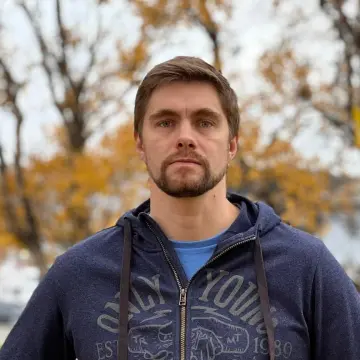
“I want to show people that Russia is more then just negativity", Rudi Ripnes said in a brief written response to the Barents Observer, declining to answer detailed questions.
A Norwegian blogger who has built a following with videos about Russia is facing questions over what critics describe as a one-sided portrayal of the country — including his denial of political repression despite a case involving his own family.
Rudi Ripnes, 25, has been publishing hundreds of videos about life in Russia since 2023, framing them as a counterbalance to what he calls “Western stereotypes.” His content, filmed largely in central Moscow — including Red Square, the metro and business districts — has attracted hundreds of thousands of followers across Instagram, YouTube and TikTok. According to him, his videos have been viewed more than 215 million times in total.
GPS – at least in Moscow – is not working how it should. I’ll try to show you. Right now I’m in Red Square, and my GPS should definitely tell me that I am in Red Square. Now I want to see where I am on the map here… Well… It’s definitely not where I am. <...> If you are driving here, that’s a big problem. It’s like this is caused by the war or the military operation, how you wanna call it..”
This is one of the few brief references to the war in Ukraine among the hundreds of videos about Russia published by the 25-year-old Norwegian.
Otherwise, he largely avoids mentioning issues such as restrictions on social media platforms — including those he uses to publish his content — as well as political repression, which has affected a member of his own family.

Ripnes began posting videos about Russia in 2023. Prior to that, he was involved in politics in Norway, participating in the right-leaning Progress Party. He took part in party voting during municipal elections in Malvik in central Norway.
Many of Ripnes’ videos are structured around contrasting what he describes as “Western stereotypes” with what he presents as the “real Russia.” In one example, he opens with the claim that Russia is supposedly dominated by unattractive Soviet-era apartment blocks, before cutting to footage of Peterhof, the Hermitage and Palace Square in St. Petersburg. In another, he challenges portrayals of Russians as “villains” by showing couples kissing on Moscow streets.
In the Moscow metro, Ripnes highlights its condition and appearance — marble interiors, decorative elements, stained glass and modern trains — comparing it favorably to what he describes as Western systems marked by crime and poor conditions.

“Why don’t we have this in the West? I always thought Norway was the ‘richest’ country in the world, but… the metro in Oslo isn’t even clean, it looks like shit,” he says in a video.
Another recurring location in his content is the Main Cathedral of the Russian Armed Forces outside Moscow. Ripnes emphasizes the scale of the building, the long queues and the number of young people and children present. He presents this as evidence that Russia remains one of the few countries where traditional values and religious life are preserved.
So called “traditional values” are a central theme in his videos, often conveyed through interviews with young women in Moscow. They describe themselves as family-oriented, uninterested in feminism and wanting children. In many clips, Ripnes frames women as the primary carriers of such values.
In his videos, Russian women are frequently shown as rejecting feminism and LGBTQ identities. “Would you accept it if your child were transgender or homosexual?” Ripnes asks in one interview. “No, I would be against it, I’m not comfortable with that,” the respondent replies.

At the same time, Ripnes often asks questions about sexual history. One of the most common is: “How many partners have you had?” The typical responses — one or two, or none — feature prominently in his most viewed videos. These are often contrasted with interviews with foreign women who report having had multiple partners.
Although Ripnes maintains that his content is not political, he addresses themes related to Russia’s international isolation. In some videos, he attempts to challenge claims that Russian athletes are absent from international competitions, citing examples including U.S. figure skater Ilia Malinin.
In an interview with pro-government blogger Liza Graf, Ripnes said concerns about restrictions on free speech in Russia are exaggerated. The video has received around 30,000 views.
“I know that if I moved here, I would have a good life… People in Europe are afraid that you can’t have your own opinion… That’s not true,” he said.
Ripnes also said that people in Russia freely express their views. “I’ve seen that people have their own opinions… they are not afraid to speak out,” he said, adding that problems may arise only in cases of “destructive concepts” about the country. He cited flag burning in the United States as an example, suggesting authorities there would also react negatively.S
However, in the United States and Norway such acts are generally protected as forms of political expression. In the United States, the Supreme Court ruled in Texas v. Johnson that flag burning is protected under the First Amendment. In Russia, similar actions can lead to criminal prosecution: in 2024, a court in the Moscow region sentenced a man to 10 years in prison for setting fire to a state flag.
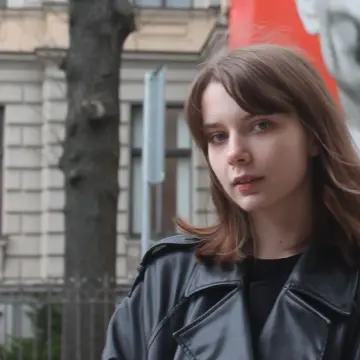
Ripnes does not mention that enforcement related to anti-war expression has affected his own family. His future wife, Russian citizen Valeria Ratova, was fined after being detained at an anti-war protest shortly after the start of Russia’s full-scale invasion of Ukraine. A Moscow court found her guilty of participating in an unauthorized demonstration and imposed a fine of 20,000 roubles. She said she had not taken part and was on her way to a restaurant.
Despite this, Ripnes publicly denies the existence of political repression.
In another video showing large numbers of security personnel on Moscow streets, he says: “Maybe you chose the wrong country if you plan to live a criminal life.”

Liza Graf, who interviewed Ripnes, is among a group of bloggers involved in promoting a positive image of Russia abroad. In August 2024, Vladimir Putin signed a decree supporting foreigners who share what are described as “traditional Russian spiritual and moral values.” Following this, Russian authorities stepped up efforts to attract foreigners from so-called “unfriendly countries,” including through social media content.
An investigation by Important Stories points to a broader network of foreign bloggers producing content that promotes a positive image of Russia to international audiences. Such material typically combines criticism of Western countries with portrayals of Russia as an attractive place to live, including for raising families.
Some of these influencers are linked to initiatives supported by Russian state structures. In August 2024, President Vladimir Putin signed a decree offering support to foreigners who share what are described as “traditional Russian spiritual and moral values.” Following this, authorities stepped up efforts to attract citizens from so-called “unfriendly countries,” including through online content.
Ripnes and Graf have appeared on the pro-Kremlin Orthodox TV channel "Spas", where foreign guests speak about their affinity for Russia. In one programme, Ripnes said he had initially viewed the country through “Western stereotypes.”
“I didn’t really know what to expect… I imagined I would go to Russia — a bad, terrible country,” he said.
He also said bloggers play an important role in shaping perceptions. “If it weren’t for bloggers… people would never see these sides of Russia,” he said.
At the same time, Ripnes does not mention that the platforms he uses to publish his content, including Instagram and YouTube, are restricted or partially blocked in Russia without the use of VPN services.
He declined to give an interview to the Barents Observer. The news outlet sent him around 20 questions, including about possible cooperation with Russian authorities, sources of funding, whether he holds a Russian bank account, and why his content rarely mentions the war or political repression.

In a written response, he said he does not consider himself a professional journalist and creates content “impulsively,” using only his phone. He added that he cannot cover all aspects of Russian society and aims simply to show that “Russia is more than just negativity.”
“That’s what’s so great about social media, it opens for discussion and different perspectives” he wrote.
In March 2025, Kremlin spokesperson Dmitry Peskov said Russia faces growing difficulties in promoting its messaging abroad due to limited presence on global social media platforms.
“We are rapidly losing tools for our propaganda work abroad… we need to figure out how to do this going forward,” he said.
Against this backdrop, foreign bloggers active on global platforms remain one of the channels for reaching international audiences.

Media analyst Ilya Shepelin said in an interview with the Barents Observer that the blogger’s content reflects narratives commonly found in Russian state media.
According to him, such videos may be based on real elements but are presented selectively, without broader context.
“Propaganda is when a source describes events without regard to reality,” Shepelin said in an interview with the Barents Observer.
He added that this type of content can create a one-sided picture and described the gap between the blogger’s statements and the case involving his wife as “paradoxical.”


