

How Sara Kelemeny reclaimed her Skolt Sámi language
Rääʹǩǩesvuõtt ja ǩiõll – Love and language.
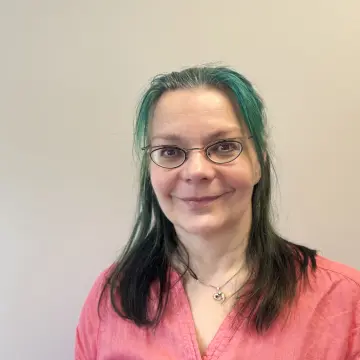
It begins with a love story, retold for generations:
“About a hundred years ago, a young Skolt Sámi man, Pekka Feodoroff from the siida of Suonikylä in Finland, falls deeply in love with the beautiful, lively Liisa Gerasimoff from the siida of Nuorttijärvi. They share a common language and a great love —but also face practical obstacles. Nuorttijärvi lies across the border, in the Soviet Union. Fraternising with Soviets is frowned upon, and marriage across the border is not permitted. Moreover, Pekka has already been promised to another woman.
But love finds a way. Pekka decides to smuggle his beloved into Finland. The entire family becomes involved, misleading and distracting Soviet border guards who pursue the couple across the terrain to prevent their escape. Reindeer caravans race swiftly through forests and over hills—but eventually Pekka and Liisa are caught.
They spend time in captivity, but are released to Finland. Neither of them ever speaks of what happened during their imprisonment. Liisa is never again able to return to or visit her family in Nuorttijärvi. Her mother, however, later crosses the border illegally to visit her daughter in Finland.
Years later, Liisa’s mother dies in Stalin’s repressions.”
Love endures, but the language slowly begins to fade.
During the next generations, the Skolt Sámi language nearly dies out – yet a spark always remains. Eventually, someone rekindles the flame. One of those people is Liisa’s Olga’s Lauri’s Sara, or Sara Kelemeny—Liisa and Pekka’s great-granddaughter.
The Barents Observer meets her ahead of the Finnlitt festival, where she is invited to speak about her first book, Kipinä ( Iiskâr )—The Spark in English.

Sara Kelemeny rose to international prominence a few years ago when the BBC included her on its list of the 100 most influential women in the world. She had successfully campaigned for funding for the Skolt Sámi language, which many had believed to be doomed. Thanks to her efforts, and those of others, the language has begun to regain strength.
Liisa and Pekka spoke Skolt Sámi to their children, but the next generation lost the language due to war and harsh assimilation policies in Finland. Skolt Sámi is critically endangered, with only around 400 speakers. Yet Sara Kelemeny chose to learn the language of her grandmother, Olga.
Iiskâr –The Spark
The book Iiskâr/ Kipinä, or The Spark, tells the story of how she reclaimed her language, word by word.
“Learning Skolt Sámi was not like learning another language—struggling with grammar like Swedish or English. Not at all. There were powerful emotions involved. But I have learned it; today I know it, and I speak it to my son. Through reclaiming my language, I have come to understand my family’s history much better.”
“I was surprised by how openly and honestly I managed to describe it all,” she adds. “It is a book about resilience within a community. I have reflected a great deal on what it means to lose a language—and to bring it back to life. The spark never fully went out. It is our language, and it has continued to smoulder.”
When she was young, Sara moved south to study in Tornio.
“But I soon thought—no, dammit! I have to get back quickly!” she says.
Her journey back was through language. She began studying her grandmother Olga’s mother tongue—a language she did not know, but had always been curious about, having heard it spoken by relatives. It was a language that spoke to her heart: Skolt Sámi.
“My grandmother is very important to me,” says Kelemeny. “I spent all my holidays with her. Every break, I was sent by post bus to my grandparents in Näätämö.”
“I had always been curious. In Sevettijärvi, I had relatives and cousins who spoke a language I didn’t understand, since I had grown up in Ivalo. I followed my grandmother everywhere, like a little shadow. As I grew older, I came to understand why the language had not been passed on to me. It was the result of both personal choices and broader societal pressures. At the time, attitudes were negative, and that influenced me too. A small language didn’t seem to matter—so I thought perhaps it didn’t matter to me either. But it did, and its importance kept growing.”
“When I began studying Skolt Sámi, it felt like entering another world. It became the language of my heart.”
Sara and her grandmother grew even closer as she began learning Olga’s native tongue. Olga had lived an eventful life—experiencing the Second World War and being evacuated twice. She married a young Finnish border guard and did not use Skolt Sámi with her children, so the language was not passed on.
“When I started learning, it was joyful. We laughed a lot together. I would come to her with my books and ask, ‘Can you help me—how should I pronounce this?’ She would look at it and say, ‘I don’t know what it says!’ She must have felt we were speaking completely different languages, as she had never learned to read or write Skolt Sámi. It says a lot about the differences between our generations.”

- Do you think differently in Skolt Sámi?
“That’s a profound question. I’m not sure—but perhaps I do.”
“Skolt Sámi is a highly endangered language. There have been times when it could have disappeared entirely—but it didn’t. In my own life, too, there have been moments when I could have given up—but I didn’t want to.”
“I wanted to highlight the importance of perseverance. People should not lose their inner selves—their language and culture—no matter how small they may seem.”
There are many other communities, beyond the Sámi, where people are striving to preserve their languages.
“We have forgotten how multilingual Finland truly is—and what a treasure that is,” she says.
Among the Sámi, there is sometimes a joke that many would prefer to be Norwegian Sámi, as resources are more plentiful in Norway. However, for the Skolt Sámi, the situation is much better in Finland.
“It is sad to see that a country like Norway offers so little support to the Skolt Sámi,” says Kelemeny. “The Norwegian state does not appear to prioritise strengthening the Skolt Sámi language or identity. This also applies to some other smaller Sámi languages in Norway.”
In Russia, the number of Skolt Sámi speakers is now estimated to be only in the tens.
“Since 2022, all contact has effectively ceased,” says Kelemeny. “We are deeply concerned on this side of the border, because we do not know what the situation is like, or whether it is even safe to make contact.”
The deliberate mistake
Eventually, Sara had completed all available courses and was offered the opportunity to work at the Sámi newsroom of the Finnish Broadcasting Company, Yle.
Yle is the only media outlet in the world that publishes news in Skolt Sámi, and Sara Kelemeny is currently its only journalist working in the language.

“I already wanted to become a journalist in secondary school,” she says. “In 2013, I got a traineeship at Yle. That was when we published the first news item in Skolt Sámi—and it happened by accident,” she recalls with a smile.
There had been plans to launch news in Skolt Sámi, but they had not yet been implemented.
“I can be a bit mischievous,” she admits. “I noticed there was a new system for publishing articles in Skolt Sámi, so I thought I would test it by writing a short news piece.”
“When my colleague returned from a break, I said, ‘Look—I’ve written a news item!’ We decided to publish it briefly, just to see if it worked, and then remove it straight away. Surely no one would notice.”
Then the editor called. “I thought: that’s it—I’m going to be dismissed”.
“‘Did you just publish a news story in Skolt Sámi?’ she asked. ‘Yes,’ I said in a small voice. ‘But we can take it down.’ ‘No, no—leave it up! It’s good that it works,’ the boss replied.”
From that day on, Yle has published news in Skolt Sámi.

“Now it seems absurd that I thought I might lose my job for publishing a short news piece in a critically endangered language,” she says.
“It means a great deal to me that, as a journalist, I can contribute to my language. Having news in Skolt Sámi is not something to be taken for granted. I feel I have an important role in raising issues in that language.”
-----------------------------
This article is published as part of an exchange program financed by Svenska Kulturfonden in Finland.


