
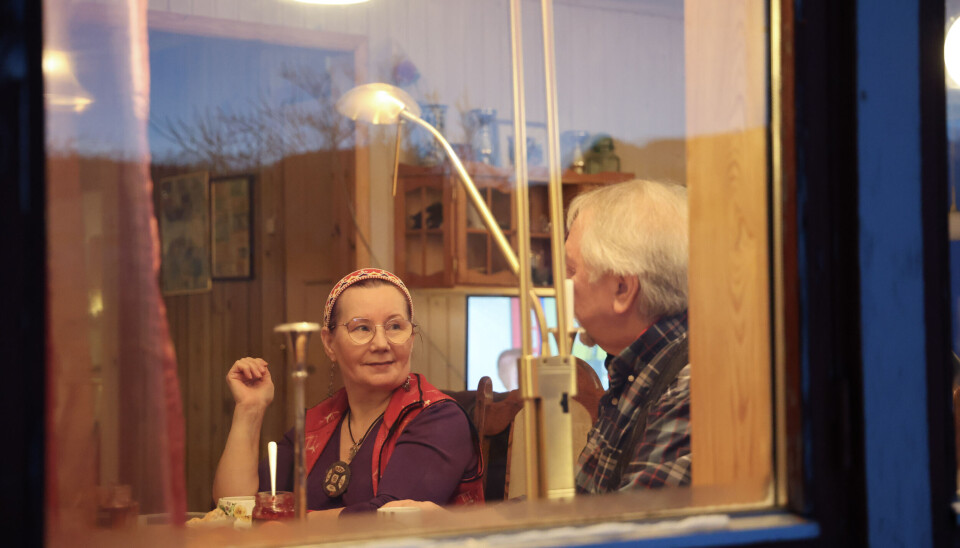
“They decided to come after us. Almost like in 1937”
Sámi activist Valentina Sovkina, originally from the town of Lovozero in Russia’s Murmansk region, was forced to leave the country after a wave of searches targeting indigenous rights activists.
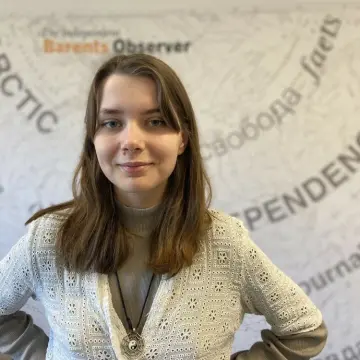
Because of her work defending the rights of her people, Sovkina has faced bans on events, sustained harassment on social media, discrimination and even physical violence. The Barents Observer tells the story of her life — and her struggle to defend the right to be Sámi in Russia today.
A “search operation”
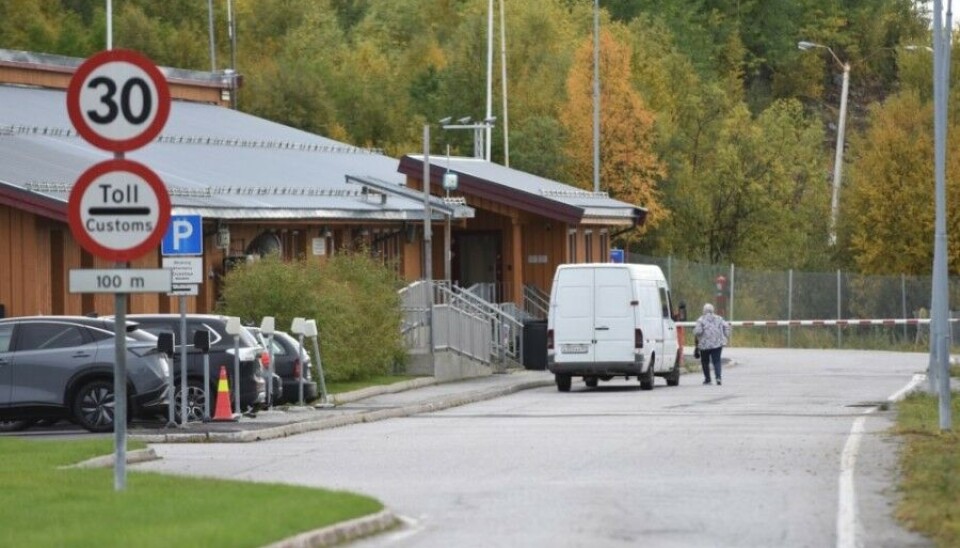
On December 19, 2025, the 62-year-old crossed the familiar border between Russia and Norway for what she believes may be the last time.
This time it did not feel like one of her usual trips abroad. There were no plans to meet relatives, no conferences on indigenous rights to attend. Sovkina was leaving Russia for the foreseeable future.
Two days earlier, on December 17, officers from Russian security services arrived at her flat in Lovozero. On the same day, the Federal Security Service (FSB) carried out searches at the homes of at least sixteen other people.
Security officers were looking for activists linked to the Aborigen Forum, a network of experts, civic leaders and organisations representing indigenous peoples of the North, Siberia and the Far East.
Sovkina woke up to a knock on the door and at first assumed it was her son, who had forgotten his keys. Instead, armed security officers forced their way into the apartment.
“I asked them several times directly: ‘Is this a search?’” she recalls. “They replied: ‘No, it’s an inspection as part of a search operation.’”
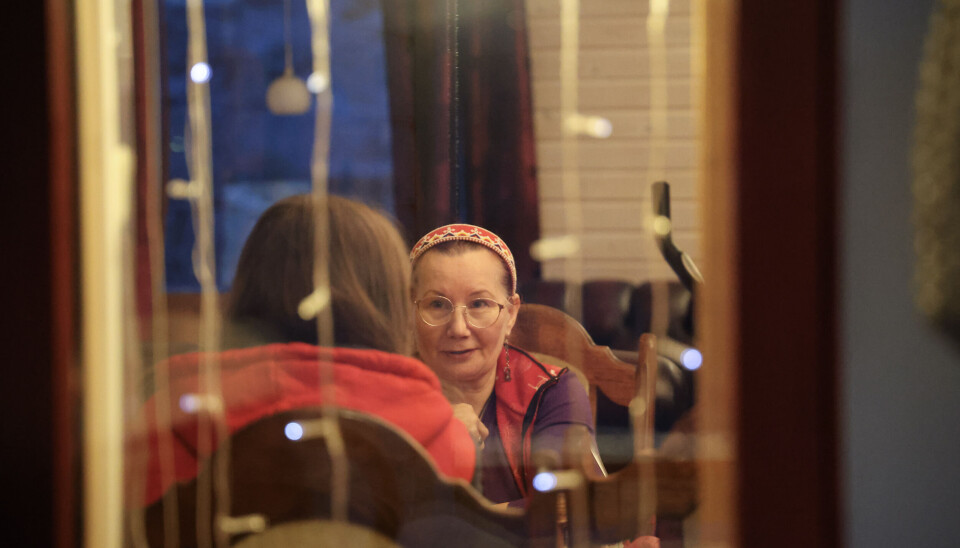
They explained that if it had been an official search, it would have looked very different.
“They said: ‘We would have burst in, thrown you to the floor, put you in handcuffs and turned everything upside down.’”
For four hours one officer carefully recorded the serial numbers of electronic devices, while another repeatedly demanded the passwords to her phone and computer.
Sovkina refused.
“So you have something to hide?” one of the officers asked.
“Yes,” she replied. “Photos of me in lingerie that I send to my husband.”
She remembers one of the officers commenting that her husband was “quite elderly”.
“Well, I’m not exactly young either,” she answered. “Do you think people stop having a life when they get older?”
During the visit she tried to unsettle the officers by speaking about omens and shamanism. On one officer’s wrist she noticed a bracelet made of shungite, a mineral often believed to promote physical well-being.
“You won’t have good health,” she told him, pointing at the supposed talisman.
That same day similar visits took place at the homes of other activists. Indigenous rights defender Daria Yegerova was later arrested by the Basmanny Court in Moscow and accused of involvement in the Aborigen Forum, which Russian authorities have designated a “terrorist organisation”.
Treated as “second-class”
Valentina Sovkina was born and raised in Lovozero, a Sámi town in the Murmansk region.
Much of her story revolves around the tundra and family life — and her childhood in a boarding school for disadvantaged children, which profoundly shaped her life.
She was sent there because of instability at home. Her parents struggled with alcohol.
“I don’t judge them,” she says. “Everything that brought them to that point was rooted in hardship. They simply weren’t needed by society.”
“What does a dysfunctional family mean? It means there are no separate beds, no desks, no school supplies. Everything is shared. We all slept in one bed — if there was a bed. Often we slept on skins.”
Their extended family lived together. Her grandparents spent much of their time in the tundra.
It was in the boarding school that she first experienced discrimination.
“The staff and visitors often treated us Sámi as if we were dirty,” she recalls.
They would say we smelled bad and look at us with disgust. They treated us like second-class people, as if we were somehow unworthy.”
Her family’s diet consisted largely of reindeer meat, fish and berries.
“That was simply the food we knew. Our homes smelled of the stove, of skins and of work. When you sew leather, scrape hides — there’s a specific smell, and it stays in the house.”
At the same time, that upbringing shaped her identity.
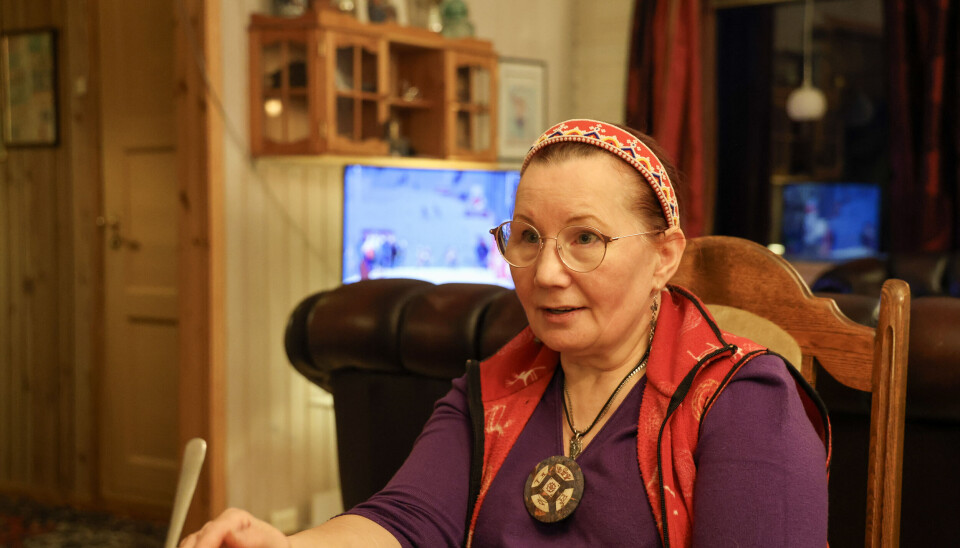
“That’s when I began to understand who I was. We had our own food, our own way of life. Reindeer stood nearby, our grandfather would arrive and we would ride them. We wore traditional clothing, the malitsa.”
She remembers waking up to her grandmother singing luvvts — traditional improvised songs.
“My tundra, my tundra, how I miss you.”
“Waving the flag”
Valentina Sovkina began researching her family roots in the early 1990s, when she found herself in hospital. In the ward with her was another woman from Lovozero who unexpectedly said: “Did you know we are related?”
Sovkina recalls how she began sketching out a family tree by hand — drawing little squares, names and connections.
“That sheet of paper became the starting point of my journey back to myself,” she says.
Later, when she entered politics, people began referring to her as someone who was always “waving the flag”.
“I had the flag everywhere,” she says. “On my computer, on my phone, a badge on my cap. I was constantly showing it — saying: here I am, I’m here, I exist.”
“They came to our land”
For many years Sovkina represented the Sámi — an indigenous people of the Kola Peninsula — in dialogue with government authorities, industrial companies and international institutions.
In 2022 she was appointed a member of the UN Permanent Forum on Indigenous Issues, an advisory body to the United Nations.
Much of her advocacy has focused on opposing industrial projects affecting traditional Sámi lands.
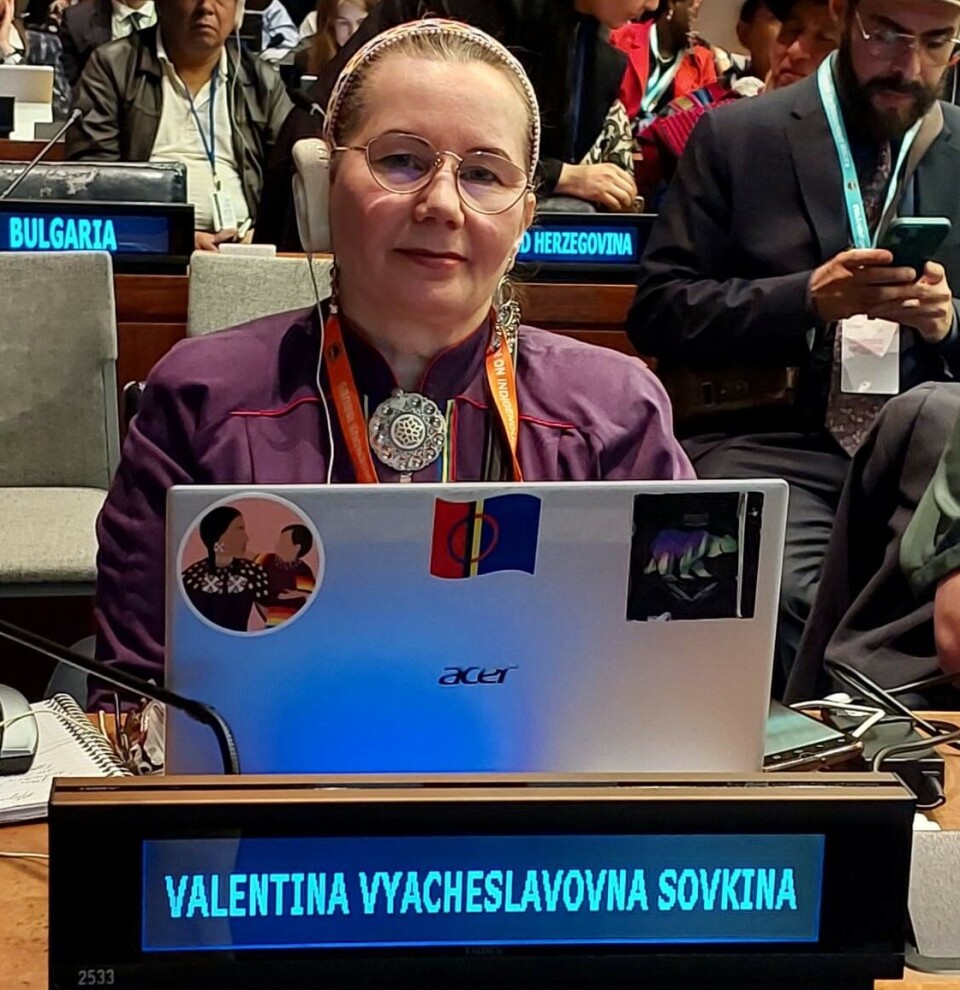
She has also criticised what she calls the “decorativisation” of the Sámi — when authorities and tourism projects use Sámi culture as a picturesque backdrop while ignoring the real problems faced by communities.
Many of her speeches have addressed the rapid industrial development of northern territories.
In the Murmansk region a key actor is the mining giant Norilsk Nickel, whose subsidiaries operate across the Kola Peninsula.
According to activists, industrial expansion is destroying lands traditionally used by Sámi communities.
In recent years the Kola Peninsula has also become one of Russia’s key sites for the extraction of rare earth metals. Alongside nickel and palladium, attention has increasingly turned to lithium.
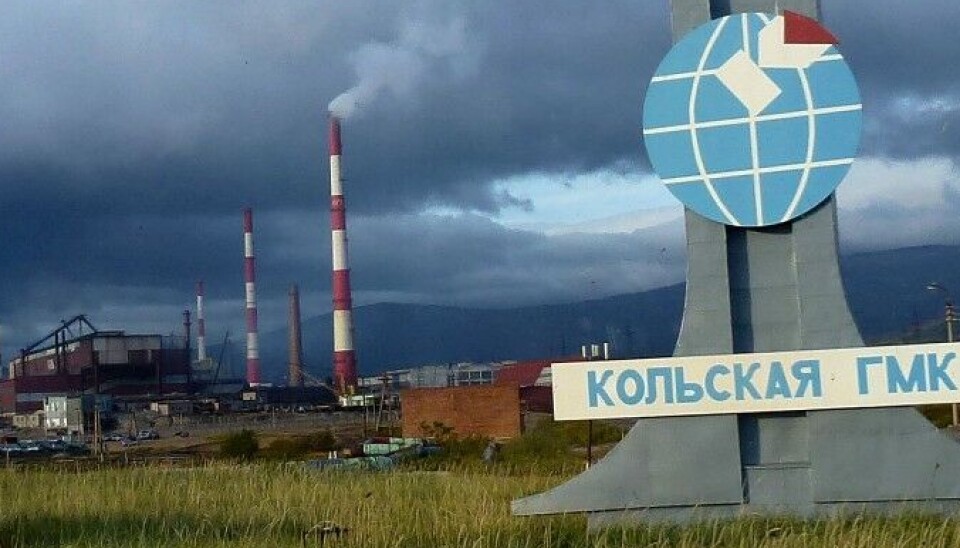
The Kolmozerskoye deposit, located near Sámi settlements and reindeer pastures in the Lovozero district, is considered Russia’s largest lithium project and a cornerstone of future battery production.
Expanding mining activity is pushing out traditional reindeer herding.
Compensation payments offered by companies, Sámi representatives say, fail to offset the long-term losses suffered by communities.
“I oppose Norilsk Nickel,” Sovkina says.
They came to our home. They want to take our land — the land where our reindeer graze. My grandfather is buried there, on an island in Lake Kolmozero.
“I understand the country needs lithium and other resources. But there are other places where extraction could happen. I don’t want them coming to our territory.”
According to Sovkina, state interests and corporate interests consistently override indigenous rights.
She points to the Association of Kola Sámi, which signed a cooperation agreement with Norilsk Nickel and receives funding from the company.
“Local indigenous leaders are often appointed from above and do not represent their communities,” she says.
“They are forced into partnerships with major corporations, which makes them dependent.”
In 2022, while crossing the border, Russian border guards took her aside for questioning.
FSB officers asked about her views on the Russian state, US policy — and finally about Norilsk Nickel.
“Ah, so that’s what this is about,” she replied. “You should have started with that.”
"To attack someone who wouldn't hurt a fly"
In 2014 Sovkina was travelling from Lovozero to the Norwegian town of Kirkenes, where she was due to catch a flight to New York for the World Conference on Indigenous Peoples.
That morning they discovered the tyres of their car had been slashed.
After finding another vehicle they set off, but police stopped them repeatedly along the road, searching the car and delaying them without formal documentation.
“The reasons kept changing,” Sovkina recalls.
“At first they said it was a routine check. Then they said it was because of Ukraine — maybe we were transporting weapons.”
Near the town of Zapolyarny the car was stopped again.
As Sovkina spoke on the phone about what to do, a young man suddenly appeared and tried to snatch her bag containing documents and her phone.
“He started pulling at the bag. I held on — he pulled harder. Then he knocked me down and began dragging me.”
She fought back, kicking and shouting.
Meanwhile the driver was being held inside a police vehicle.
When he ran out to intervene, the police detained him — not the attacker.
“They grabbed the driver, not the attacker. The man simply ran away,” she says.
“It looked like a staged performance. A circus.”
The case was never properly investigated.
During later interrogations, one investigator suggested the officers had merely been following orders.
“I asked: whose orders? He said nothing. And I realised — even if they had killed me, it would still have been an order.”
It was after this, says Sovkina, that her attitude towards the state changed completely.
Now I am absolutely certain that I am not safe. You have shown that you can attack someone who wouldn't hurt a fly. You have completely changed my inner compass. I believed that the state was capable of protecting me."
She did fly to New York after all — a day late. She still has her passport. Other Russian participants in the conference were less fortunate: some of them were unable to leave, and some had their documents confiscated at the airports.
“The authorities don’t want us to be independent”
Pressure on Sámi activists long preceded the recent criminal cases under “extremism” and “terrorism” laws.
Sovkina says the first signs appeared when authorities began systematically obstructing attempts to organise meetings.
Whenever she arranged seminars or discussions in Lovozero, venues suddenly became unavailable.
“They would say there were fire safety problems, or a burst pipe — always something.”
Eventually she concluded it was pointless to request space in public buildings.
“People who wanted to help were warned they might face consequences — that they could lose subsidies.”
She is convinced the FSB was behind the pressure.
Sovkina recalls how an unknown man came to an open event in Lovozero and asked permission to participate. He introduced himself as a ‘physical education teacher,’ but, as Valentina says, ‘it was immediately clear from his bearing that he was a security officer.’
"I told him, 'Sit down. We have no secrets. You can write everything down. We won't even speak in Sámi — we'll speak in Russian so that you can understand everything."
For two days, climate and oceanography experts discussed climate change, risks to the territory, long-term and short-term planning for Lovozero, and measures to be taken by the administration in the event of avalanche danger and other threats. After the meeting, the ‘physical education teacher’ approached Sovkina and asked a question:
"I still don't understand — what are you doing here that's so dangerous?"
Fighting the governor
Until 2010, Sámi Day, celebrated on February 6, was marked by the raising of the flag near the Murmansk regional administration building. However, activists later began to encounter problems.
Sovkina recalls how, in 2010, activists planned to raise the flag at the administration building. The governor did not appreciate the idea. "They went so far as to cut down the flagpoles so that we couldn't raise the flag near the building," says Sovkina, "so that there would be no topic for discussion. It turns out that even the government discussed it...
"How can we allow the flag to be raised? What if LGBT people come and demand the same thing?"
The Sámi responded with a protest: they came to the Murmansk administration building with drums and horns. Valentina was offered a compromise: "You raise the flag for half an hour, then take it down." She agreed, and the flag hung for a whole week.
It is not in their interest for us to be independent, it is not in their interest for us to be financially secure. We always talk about our territories, about the ancestral nature of these territories. We do not live in four districts. We live throughout the Murmansk region and have always lived here."
In the autumn of 2024, the authorities added the Free Nations of Postrussia Forum to the list of “terrorist structures" and declared 172 other initiatives to be its ‘structural subdivisions.’ The list included anti-war and decolonial projects, as well as movements for regional autonomy.
In addition, the Ministry of Justice recognised the ‘Anti-Russian Separatist Movement’ as extremist — an organisation that the ministry essentially invented itself by analogy with the ‘International LGBT Movement’ and the ‘International Satanist Movement.’
"This story is as old as the world itself"
Since 18 December 2025, Daria Yegereva, whose home was searched at the same time as Sovkina's, has been in custody. The indigenous rights activist and representative of the Selkup people is accused of ‘aiding terrorist activities.’
Sovkina condemned the persecution of activists.
"It is particularly outrageous that the Russian authorities are accusing activists of terrorism, for which people who have not committed and never called for violence are now being given monstrous prison sentences of 15 or 20 years in Russia. These sentences are not intended to “combat terrorism” but to intimidate. They have targeted those who have led and continue to lead a traditional way of life for centuries, herding reindeer, fishing, hunting and gathering wild plants on their own land. They preserve their knowledge, their knowledge of nature, bit by bit."
We must call a spade a spade: this is not a fight against terrorism, it is political revenge."
This is direct punishment by the state for the fact that representatives of Indigenous Peoples dare to appeal to the UN, speak about violations of their rights, participate in the work of international bodies and tell the truth about what is happening in Russia. The Russian authorities are deliberately criminalising the very idea of cooperation with the United Nations.
"This story is as old as the world itself — accusations of separatism, unwillingness to allow indigenous peoples to participate in decision-making, and the desire to maintain control over territories. This is exactly how colonial policy manifests itself," says Valentina's husband, Bjarne Store-Jacobsen.
Bjarne remembers the day of the search at Sovkina's house well — he watched what was happening from his home in the municipality of Nesseby, 100 kilometres from Kirkenes. Barents Observer journalists met with Valentina there.
Like Sovkina, Store-Jakobsen is a well-known Sámi activist. At the beginning of his political career, he became one of the key figures in the Sámi rights movement, in particular opposing the construction of a hydroelectric power plant in Alta, northern Norway.
Despite their similar political backgrounds on opposite sides of the Russian-Norwegian border, the activists did not meet until they were older. In Norway, Store-Jakobsen worked as a journalist throughout the 1980s and 1990s, and in 2005 he was elected to the Sámi Parliament of Norway. Three years after returning to politics, the parliament sent him to represent the Sámi in international Arctic cross-border cooperation.
The council was established in 1993. Thirty years later, in 2023, Russia was removed from participation in this cooperation after launching a full-scale invasion of Ukraine. Despite living on different sides of the border, Sovkina and Store-Jakobsen maintained their relationship, meeting regularly. In 2020, they got married.
"She had a few days to leave the country. Otherwise, she would have been arrested," believes Bjarne Store-Jakobsen.
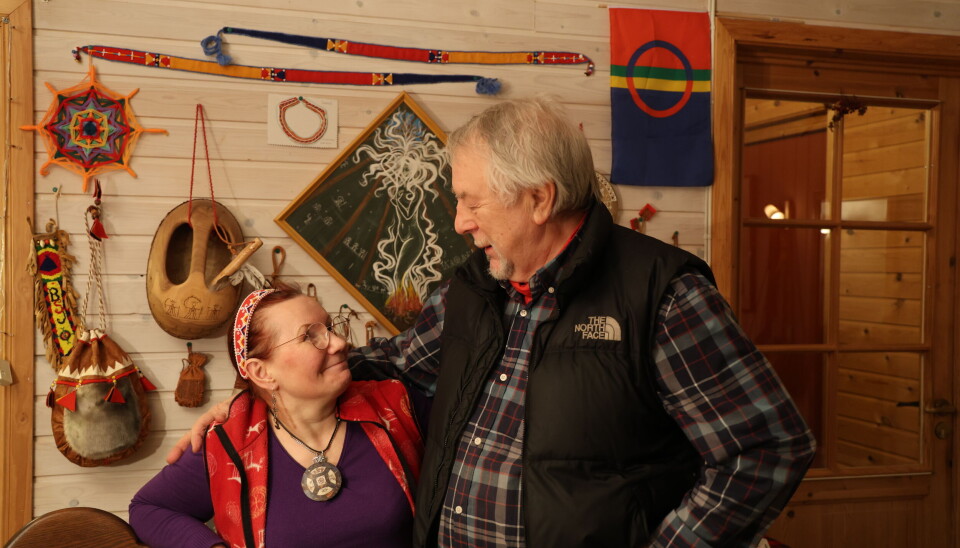
The decision to leave Russia was difficult for Valentina, and she sometimes thinks about returning. But the possibility of ‘terrorism’ charges and the concern of her loved ones pushed her to take this step.
"It seems that my departure is an escape. But that's not in my nature. Sometimes I think I'm ready to drop everything and go back — and let everything burn. I want to know what's going on in my family. But if I'm deprived of the opportunity to speak, it won't do anyone any good."
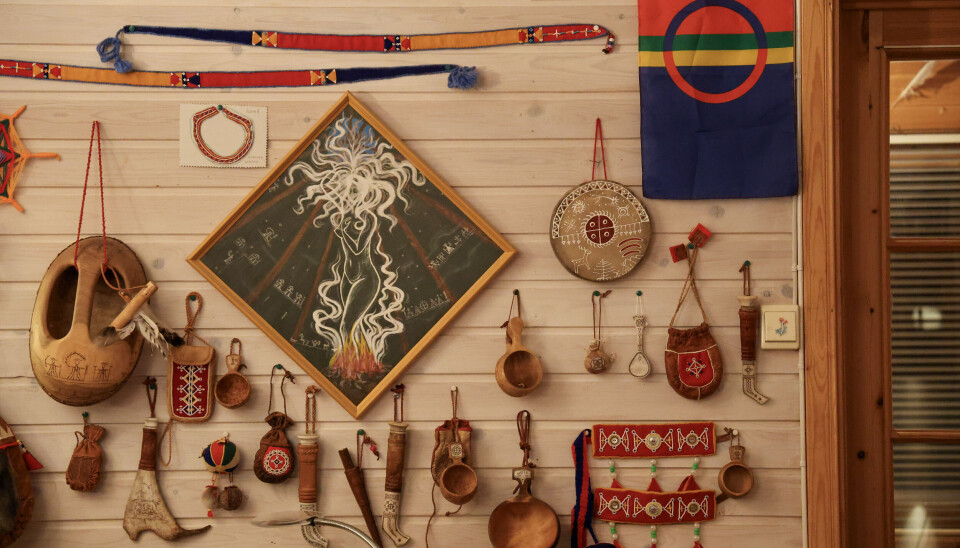
Sovkina is currently awaiting a decision from the Norwegian Directorate of Immigration (UDI), to which she has applied for a residence permit on the grounds of family reunification. The UDI documents hang on the wall of her office.
Despite the fact that she now lives a normal life, Sovkina cannot shake the thought of returning to Russia. Even the understanding of the possible consequences — including imprisonment — does not deter her.
Echoes of Stalin’s terror
Today Sovkina draws a direct historical line between the repression of indigenous activists and events remembered by the Sámi as the “Sámi conspiracy”.
During Stalin’s purges in 1937–1938, Soviet authorities accused Sámi intellectuals and community leaders of forming a “counter-revolutionary nationalist organisation.”
They were charged with espionage, ties to Norway and Finland, and plans to separate the Kola Peninsula from the Soviet Union.
Among those arrested was Vasily Alymov, director of the Murmansk Regional Museum of Local History. About thirty other people were also repressed along with him. Most of them did not return: 15 people were shot, and 13 were sentenced to 10 years in prison.
When asked how often she herself was accused of separatism, Sovkina replies, ‘Practically all the time.’ After one of her speeches at the UN, a pro-government media outlet published an article in which accusations of separatism appeared on every other line.
"I read it and thought: my God, it's 1937 all over again. Another “conspiracy”, another search for enemies where people are simply talking about their rights."
"In essence, they have now decided to take us “under their wing”. The “Sámi conspiracy” involved doctors and scientists. And all because they were preserving their knowledge. What power that must be! That's why I have no moral right to give up."
"But I have an inner feeling that this will all end quickly. I believe in that."


