

“Do not abandon the watchtower”
Ambassador Oleksiy Gavrysh says Ukrainian experience and technology can be applied along Norway’s border with Russia. “Here in Kirkenes, you stand on the front line. You are the main watchtower of the democratic world in the north.”
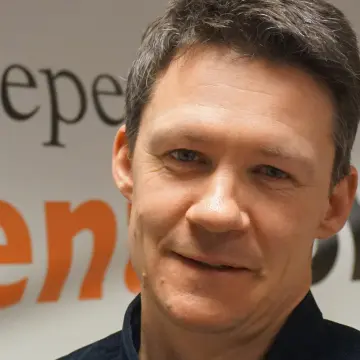
Gavrysh grew up in Donbas and knows what it means to flee from Russian aggression.
“I speak to you as a man who has personally walked through this hell. In 2014, when Russia began the first phase of its occupation of the Ukrainian Donbas, my home was bombed,” he told participants at a conference in Kirkenes, the Norwegian town located only a few kilometres from the Russian border.
“I decided to leave, take my family, wait it out, and build a new life in a safe place. I thought I could simply take shelter from the war. That year, I lost everything — my home, my belongings and my past.”
When the war began, Ukraine was not prepared, Ambassador Gavrysh explained.
Oleksiy Gavrysh was appointed Ukraine’s ambassador to Norway in April 2025. He has more than 20 years of professional experience from several leading Ukrainian companies. In 2022, he became chairman of the board of Naftogaz Group, and in 2023 he was appointed adviser to the State Secretary of the Ministry of Defence.

The ambassador urged Norway to remain vigilant and strengthen preparedness. In the event of crisis or war, Norwegians should choose “fight” over “flight”, he emphasised — even if leaving appears to be the easier option.
“In the High North, a region characterised by vast distances, a harsh climate and critically low population density, the illusion of flight or planned evacuation appears particularly tempting. It seems rational to leave, wait out the storm in a safe place and save lives. But this is a deadly misconception.”
“Learn from our mistakes. Do not abandon the watchtower,” Gavrysh said.
“Here in Kirkenes, you stand on the front line. You are the main watchtower of the democratic world in the north.”
“If you yield even a single metre of your land, if you run, the aggressor does not stop. He takes your home, accumulates resources, builds new bridgeheads, and a few years later he comes again in a new way.”
In a conference hall located less than ten kilometres from the Russian border, the speech made a strong impression.

The Kirkenes Conference was once a venue for Norwegian-Russian dialogue and cross-border cooperation. Today, it has become a security-focused event centred on Russian threats.
The small Norwegian town of Kirkenes has undergone a profound reality check. For almost three decades, it proudly branded itself as a “bridge between east and west” and a “laboratory for cross-border cooperation”. Today, it is increasingly seen as an exposed frontier community and a target for Russian subversion and disinformation efforts.
Gavrysh acknowledged that Norwegians may previously have been naïve regarding Russia. At the same time, he also praised what he described as a valuable Norwegian characteristic.
“It’s a great treasure to be naïve in this world. You should preserve this treasure, but you must protect it with a high level of critical thinking, like a shield or armour.”

In an interview with the Barents Observer, the ambassador said relations between Ukraine and Norway are increasingly becoming a mutually beneficial partnership.
How would you characterise current Norwegian-Ukrainian cooperation?
“Friendship. Friendship and fellowship for our future. Right now, I can say that the quality of our relationship has changed from a donor-recipient model into a mutually beneficial partnership.”
What is the current state of cooperation between Ukrainian and Norwegian armed forces?
“It is becoming increasingly active. Ukraine has demonstrated that warfare has changed dramatically. It is very important to modernise the Norwegian armed forces and prepare defence structures for a new phase of war — a new kind of war involving large numbers of unmanned systems and drone technologies.”
The Norwegian National Audit Office recently published a positive assessment of the Nansen Programme. What is now most needed from countries like Norway?
“We greatly appreciate the financial support and we are very encouraged by the technological cooperation in the defence sector. I would be very pleased to deepen this cooperation and make it even more successful and beneficial — not only financially, but also through technological solutions and practical results.”
Along the Norwegian coast, many so-called shadow tankers continue to operate. How is Ukraine fighting Russia’s shadow fleet?
“We are increasing international attention to this problem. You are absolutely right that the Russian shadow fleet operates in many different seas and maritime regions. It is therefore essential to cooperate closely with our partners against what is effectively an economic weapon of Russia. I can confirm that we and our partner countries do a lot in this field.”
I want to remind you that every dollar invested in this business returns in the form of drones, Shahed attacks and missiles that kill civilians in Ukraine.”
Kirkenes is located very close to the Kola Peninsula, a region heavily involved in the war. Can we expect more Ukrainian strikes against the Kola Peninsula?
“Ukrainian forces strike military or strategically important military targets on Russian territory as a mirror response.
We do a lot to try to stop this war, to negotiate with Russia about a ceasefire, about any kind of efforts to stop this war. But Russia does nothing. They ignore all our steps and all our propositions."
Ukrainian drones can now reach more than 2,000 kilometers into Russia. So you can actually cover the whole targets in the Kola Peninsula and also other parts of the Russian Arctic.
One more time; Ukraine will never attack the Kola Peninsula or the Arctic. Only Russian military objects.
The war is also an information war. How does Ukraine fight Russian propaganda and disinformation?
By increasing the level of critical thinking. It is impossible to jam or to block all channels of propaganda. We do a lot in this field, but the most important thing is to increase the self-preparedness and self-defence against the propaganda with critical thinking. And these very important issues should start from kindergarten and continue through all your life. You have to increase these skills.
So this is also something you do with kids in Ukraine?
Not only with kids. With all Ukrainians. It's not about the Russian propaganda only. It's about the quality of your life. Critical thinking in the modern world is one of the most important skills.
Talking about propaganda. Russia claims that Norway is assisting Ukraine in alleged plans to blow up Russian tankers along the Norwegian coast. How do you respond to such claims?
"Let me not comment the Russian fake news and propaganda issues. Let's talk about the facts."
How can Norway and all of Europe learn from Ukraine’s experiences with drones and drone technology? How can Ukrainian drone experiences be applied in Kirkenes?
"Ukrainian drone technology is not only for defence purposes, but for logistical purposes, for environmental purposes, especially in the Arctic seas. For Coast Guard services, rescue services, evacuation services, for example. On the front line, only last month Ukraine had 347 successful cases of the evacuation of wounded soldiers from the front line. This is not only for the use of drones, but also for the use of robotic platforms. And even maybe for the agricultural sector. Or for the control of wild animals, migration, etc.
We are more than happy to help you to work with the technologies, to implement and to update it."
In Norway, 2026 has been designated the Year of Total Defence. How do you explain Ukraine’s resilience?
"As I mentioned in my speech today, at the beginning of the war, unfortunately, we were not ready. So the level of our first fight was extremely low. And we paid a high price. You have unique opportunities to change your focus on preparedness, not only for war, but for any other kind of challenges of the new world. And it's very important because it's a big mistake to expect that only the army can defend the country. But the cooperation of a well-prepared civil society and the army, police department and emergency service together can create a solid defence system. As for me, that's what total defence means. Understanding the role of each citizen in the defence of your country."
When you follow the public debate in Norway, do you think that Norwegians are naive with regard to Russia?
"Yes, but naivety is a treasure. It's a treasure and I'm happy that you have it. Because you're unique and I love this characteristic of Norwegians, this naivety. And a lot of your successful stories are based on your naivety. So you must keep it, but you have to add a layer of critical thinking. And I have seen during my year as an ambassador that you have changed your focus considerably. Now you can identify and react more to Russian provocation, propaganda, narratives.
So you're waking up. Yeah."
We still have a Russian general consulate in this town.
"You are a democratic country and diplomacy remains important, even during times of war and tension. And historically I remember that this region was very dependent on Russian cooperation.
This is a border region like Donbas. Donbas has paid such a high price, extremely high price, astronomically high price, for its naivety and passive position.
This is a challenge for all border regions neighbouring Russia. In the Sumy-Chernihiv region I can confirm how they have positively changed. The level of preparedness is extremely high.
How can Ukrainian and Norwegian civil society cooperate?
"In a lot of spheres. A lot of spheres. Historical, cultural, business, defence, music, artists, medicine, agricultural issues, seafood processing. A lot of logistics. A lot of points of cooperation. We have very, very old historical bridges between our countries. We have to maintain these bridges and build new ones."


