

Orthodox ultranationalists bond with nuclear forces on Novaya Zemlya
An archconservative and xenophobic organisation with ties to the Moscow Patriarchate was represented at the opening of a new cathedral in Belushya Guba, the town that serves Russia’s Arctic nuclear test site.
There was a solemn celebration in the far northern military town as a new church was officially opened on 1 August.
Present at the ceremony were leading representatives of the 12th Main Directorate of the Ministry of Defence, a secretive military department responsible for Russia’s nuclear weapons arsenal. Among them was Sergei Getman, Deputy Head of the Directorate’s so-called military-political work.
The ceremony and church service were headed by Bishop Safrony of Naryan-Mar, who was assisted by Archpriest Aleksandr Soldatenkov, a chief prelate at the Main Cathedral of the Russian Armed Forces in Moscow.

Soldatenkov had brought with him a group of singers from the choir of the Russian Engineering Troops, an ensemble that normally performs at the Moscow cathedral.
The chorus, all dressed in parade uniforms, added a majestic touch to the ceremony. However, present in the room were not only well-dressed military men and Orthodox prelates.
In photos and videos from the event, a group of civilians can be seen, one of whom is wearing a sweater with the logo of the organisation Sorok Sorokov.
Sorok Sorokov is considered one of Russia’s largest fundamentalist Orthodox organisations. It was reportedly established in 2013 as a response to the "blasphemous" stunts conducted by the punk group Pussy Riot.
According to the organisation, it is working to "preserve the spiritual and moral values of the Russian World." It reportedly has more than 10,000 followers and organises rallies and parades across the country. The members have been described as the "Patriarch’s stormtroopers" and the "Russian Orthodox Church’s combat units."

"We realise that the main cause of the nation’s misfortunes is a break in its relationship with God," the organisation states on its website.
It is actively involved in supporting Russia’s war of aggression against Ukraine and says one of its main missions is to "dispel myths about Orthodoxy as a ‘religion of the weak.’"
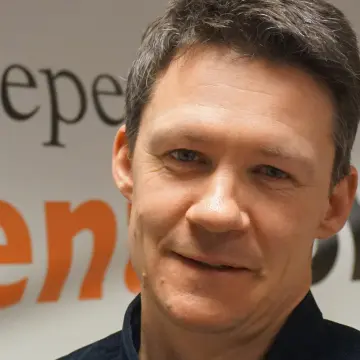
Sorok Sorokov was founded by Andrey Kormukhin and Vladimir Nosov, both of whom were present at the ceremony in Belushya Guba. The former, a father of nine, has reportedly been involved in several attacks against LGBT people.

Kormukhin wore a sweater with the organisation’s logo at the ceremony. The logo shows Dmitry Donskoy, the 14th-century Moscow prince, with a sword and a shield in front of an Orthodox church.
Prince Donskoy fought the Mongols and extended the power of Moscow. He is a figure actively used in current Kremlin propaganda. In August this year, Putin announced that he plans to transfer the remains of the prince to the war zone in Ukraine in a bid to lift the spirits of Russian warriors.
Vladimir Nosov is a former boxer who has established himself within the apparatus of the Orthodox Church. He is today a member of the Patriarch’s so-called Sports Commission, a structure headed by Metropolitan Mitrofan of Murmansk.

In a video recorded on the plane from the mainland to Novaya Zemlya, Nosov praises the work of the nuclear forces of the 12th Main Directorate.
"Let us remember, my friends, that 24 hours a day, 7 days a week, 365 days a year, we are under the protection of these brave people and, of course, the Lord God! As the Scripture says, His presence is clearly felt here in a very special way."
The name Sorok Sorokov translates to Forty Forties, an idiom that refers to the great number of churches in old Moscow.


In addition to Sorok Sorokov, there were also representatives of another fundamentalist Orthodox quasi-religious organisation present in Belushya Guba. Russky Krest (Russian Cross) describes itself as a foundation that works to preserve Russia’s spiritual and cultural traditions and "present an accurate image of the Russian people to the international community."
Like Sorok Sorokov, Russky Krest is closely connected with the boxing community in Russia. The organisation was founded by Umar Kremlev, the Putin-loyal President of the International Boxing Association. On the board of the organisation are several other boxers, including Aleksandr Besputin, the General Secretary of the Russian Boxing Federation, and Maksim Kotkov, an adviser of Kremlev at the International Boxing Association.
Interestingly, the organisation's Board of Trustees includes famous Russian rapper Yegor Bulatkin, known by his stage name Yegor Krid.
On the board is also a prominent regional representative of the Night Wolfs biker club.
Representing Russky Krest in Belushya Guba was its former president, Yevgeny Blagov, now supposedly an adviser to the Board of Trustees.
A video shows Blagov walking in Belushya Guba and attending the church service.
"The Russky Krest visited Novaya Zemlya in the Arctic and took part in a historic event – the consecration of the church dedicated to St Seraphim of Sarov," the organisation reports.
Blagov reportedly has several awards from the Russian armed forces, as well as from Russian proxy authorities in Luhansk and Donetsk, and the Russian Orthodox Church.
Both Sorok Sorokov and Russky Krest actively support the construction of new churches across Russia and may have provided financing for the cathedral in Belushya Guba.
Their visit to one of Russia’s most secret and closed military sites illustrates an increasingly close relationship between Russian authorities, including the Armed Forces, and far-right quasi-religious and militant groups.
Over many years, and especially after the start of the full-scale invasion of Ukraine, the Kremlin has teamed up with and supported ultraconservative public organisations to meet various objectives. Putin and his administration have also been instrumental in the establishment of such groups, among them youth organisations such as VOIN and Pervykh.
Novaya Zemlya is Russia’s Arctic nuclear test site. Between the mid-1950s and 1990, a total of 132 nuclear weapon tests were carried out on the archipelago, including the 50-megaton Tsar Bomba and nuclear torpedoes. Today, Novaya Zemlya remains one of Russia’s most closed and militarised areas and is still used as a test site for new weapons, including the Burevestnik nuclear-powered cruise missile and the Poseidon nuclear-powered torpedo.
The foundation stone of the new cathedral was laid on the frozen ground of Belushya Guba in 2024. The new church is built with timber from Arkhangelsk and has a 650 kg golden dome. Reportedly, it has space for 150 people.
According to Sergei Getman, Deputy Head of the 12th Main Directorate for Military-Political Work, the new cathedral is a "place of strength that sustains the spirits of our servicemen and their families."
"A true spiritual stronghold has emerged here on Novaya Zemlya," Getman said.


