
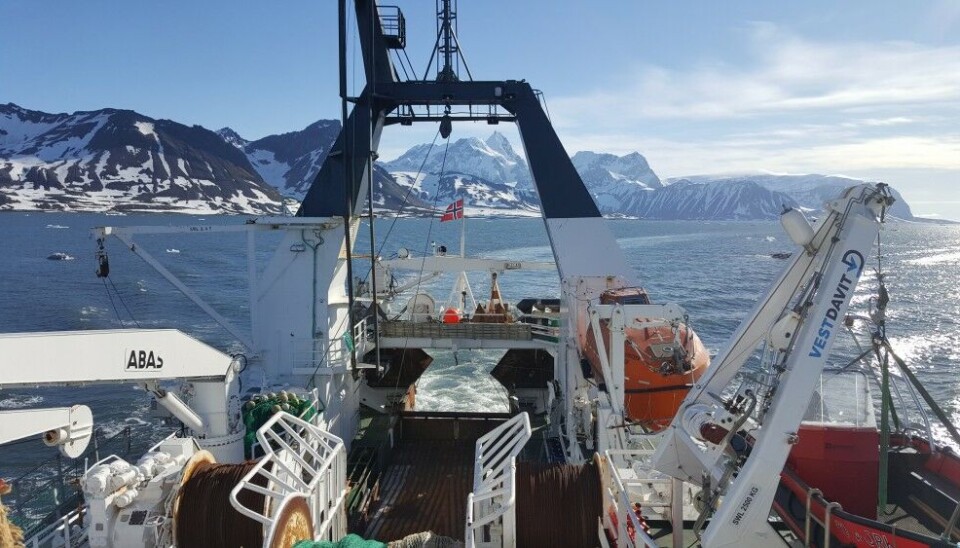
Significant rise in temperatur in the eastern Barents Sea affects spawning grounds, study says
The surface temperatures have in recent years been 0.5 to 2.5 degrees higher than previous average, according to the report.

Especially the northern and eastern parts of the Barents Sea are affected, according to a new study.
A significant rise in temperatur in the Barents Sea affects spawning grounds and the general food base for several species in the coastal ecosystem, according to a recent resource overview published by the Institute of Marine Research.
The results were released during the Arctic frontiers conference in Tromsø in early February 2026. The timing was no coincidence, the director, Nils Gunnar Kvamstø, emphasized before revealing the results.
"People in the North know better than anyone how existentially important it is to have an overview of fish stocks in our sea areas. When geopolitical tensions increase, it becomes even more important to secure food supplies. The competition for natural resources becomes much stronger," he said before introducing the report.
Further, he mentioned the increasing importance of managing the sea areas in a sustainable way despite geopolitical tensions and climate change.
"Sustainable management is even more challenging now than before," he said.
High temperatures in the High North
Shortly afterward, his colleague, Geir Huse, presented graphics illustrating the changes in temperatures during the last thirty years. According to the report, the surface temperature in Norwegian waters has been 0.5 to 2.5 degrees higher than average over recent years.
The deep red colors however, appears in the High North.
"It was especially warm at the sea surface west and north of Svalbard and far east in the Barents Sea," the report states.

The red colour visualises warmer temperatures at the sea surface, and measurements include depths down to 200 metres. The measurements show more stable temperatures deeper into the ocean.
The decrease in fish stock show similar patterns, as pelagic fish are suffering a larger loss in biomass than demersal fish, according to the resource overview.
Plankton scarcity
Both high temperatures and lack of plankton are factors mentioned as contributing to a significant loss in fish biomass.
Arne Pedersen, head of the Eastern Finnmark Fishermen's Association, emphasizes the crucial role of plankton, the primary food source for the local fish stock.
"The Calanus plays a central role in our ecosystem. Even whales rely on this plankton,” he says, further emphasizing that the local fishing industry is being affected by its scarcity.

Spawning fish in the fjords rely on Calanus as a key food source, meaning that a decline in plankton has direct consequences for the species targeted by local fishermen.
“Norway’s principal fishery has always focused on spawning fish, both on the spawning grounds and as they migrate into the spawning areas,” Pedersen says.
Geir Huse, Director of Marine Ecosystems and Resources at Institute of Marine Studies, says that north's most commercially important stocks, such as the Arctic cod, have reached a critical level.
"This is primarily due to a failure in recruitment - not enough young fish are growing up. But in recent years, more Arctic cod has also been harvested than recommended."
In December 2025, Norway and Russia agreed on the lowest cod quota since 1991.
Lowest since year 2000
Pelagic fish suffer the most according to the resource overview, but the total fish biomass has reached its lowest number since the year 2000.
Overall, the fish stock in the seas surrounding Norway has been reduced by half since 2013. At that time, the Institute of Marine Research recorded a total biomass of approximately 35 million tons.
Arne Pedersen notes that the fish stock has now reached a critical level, and he stresses that all fishing activity must be significantly reduced.
“Locally, we have a fjord where the fish can no longer spawn sufficiently. We must leave the spawning grounds to recover in order to secure future harvests.”


